Official audio guide · English
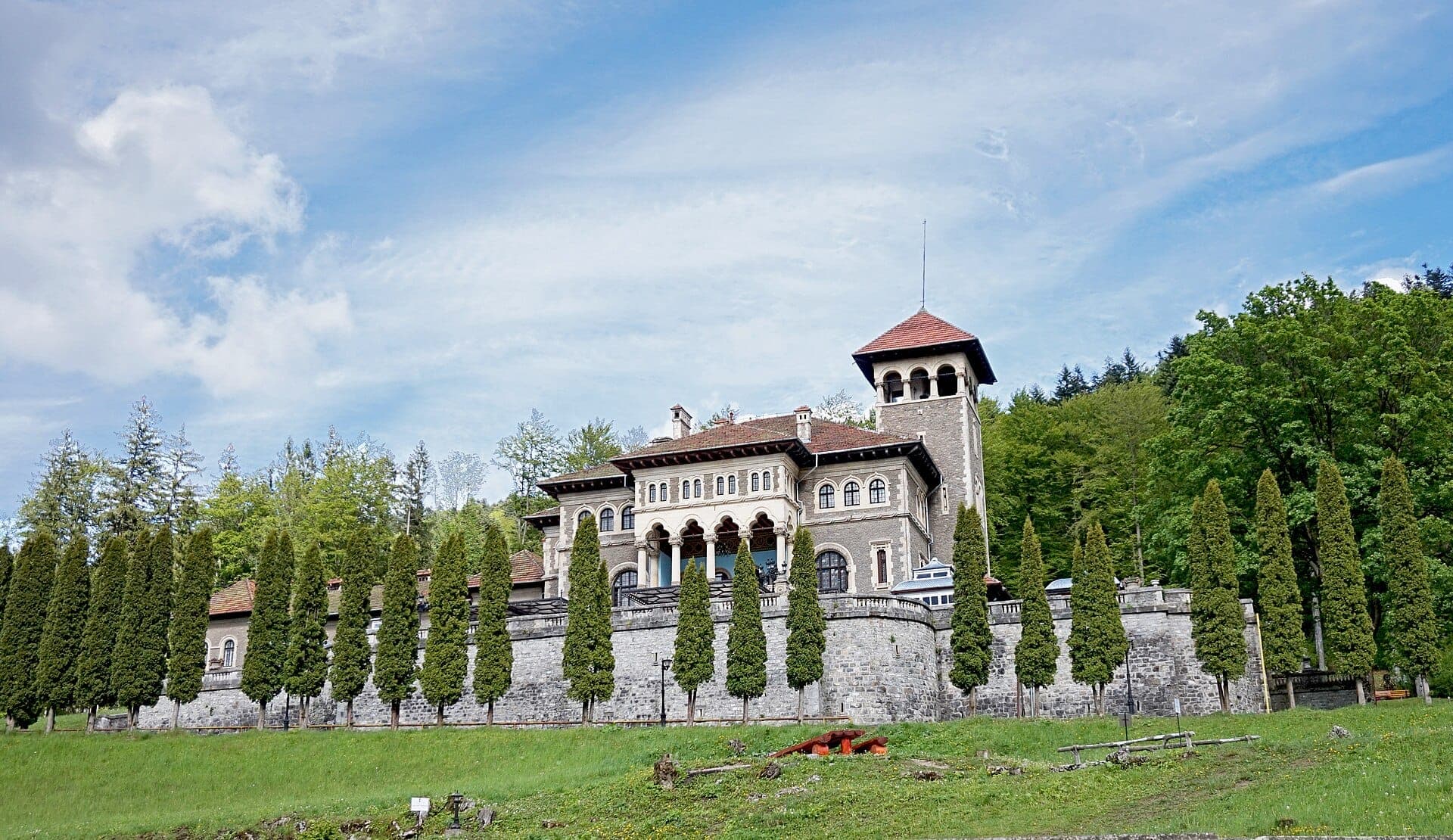
Cantacuzino Castle
Complete audio guide to Cantacuzino Castle in Bușteni: the family's story, the interior route, the world of the series Wednesday, and the park overlooking the Bucegi Mountains.
How to use this audio guide
- Listen to the tracks directly from this page, or download them with each track's button for offline use.
- Every track carries the number and name of the room: if the museum route changes order, simply pick the matching track.
- Use headphones and respect the silence of the rooms. Enjoy your visit!
The castle route
The interior is visited on a guided tour; these tracks complement it
Read the text
Welcome to Cantacuzino Castle, the hidden jewel of the Prahova Valley — and, for the past few years, a world star thanks to a certain academy for outcasts called Nevermore. But let's take things in order, because this castle was extraordinary long before Netflix. A practical note first: the interior is visited on the castle's own guided tour, which departs every hour; our tracks are designed to accompany and enrich that tour, or to be listened to at leisure before or after, while you stroll the park or enjoy the terrace. You are in Bușteni, at nearly nine hundred metres of altitude, facing one of the most imposing views in Romania: the stone wall of the Bucegi Mountains, with the cross of Mount Caraiman etched against the sky. In this setting, one of the richest men in Romanian history decided to build himself a summer palace that would sum up eight centuries of family history. His name was Gheorghe Grigore Cantacuzino, and the whole country knew him by a nickname that says it all: the Nabob. His story awaits you in the next track.
Read the text
Gheorghe Grigore Cantacuzino was born in 1832 into one of the most illustrious families of south-eastern Europe: the Cantacuzinos, who trace their lineage to none other than the Byzantine emperors — the Kantakouzenos dynasty that reigned in Constantinople in the fourteenth century. Inheritances, land, forests and oil made him the richest man in Romania; popular legend baptised him 'the Nabob', after the fabulously wealthy princes of India. But he was not merely rich: he was twice Prime Minister of Romania, leader of the Conservative Party, mayor of Bucharest, and a patron who spent fortunes on palaces and culture. His, too, is the splendid Cantacuzino Palace on Bucharest's Calea Victoriei, today the George Enescu Museum. Between 1901 and 1911 he raised here, in Bușteni, his definitive summer residence, entrusting the design to Grigore Cerchez, one of the great architects of the Neo-Romanian style. The Nabob enjoyed his dream only briefly: he died in 1913, two years after completing it. But he left his testament in stone: a castle that proclaims, in every wall, eight centuries of family pride.
Read the text
Before going in, give the building a few minutes. Cantacuzino Castle is one of the masterpieces of the Neo-Romanian style — the movement that, at the start of the twentieth century, set out to create a modern national architecture by drinking from its own sources: the monasteries of Wallachia, the palaces of the Brâncoveanu princes, the boyar houses with their columned porches. Notice the combination of stone and brick on the façades, the trefoil arches of the loggia, the short, sturdy columns with carved capitals, the deep wooden eaves. It is a language that will feel different from anything you have seen in Western Europe: neither Gothic nor Renaissance, but profoundly Romanian, with Byzantine and oriental echoes. The architect Grigore Cerchez, trained in Paris, was fluent in the European styles and chose this one deliberately: at the height of the fashion for French and German-style castles, the Nabob wanted a house that proclaimed his land and his lineage. Notice, too, the tower and the stepped terraces in dialogue with the mountain. The building does not compete with the Bucegi: it leans on them, like a boyar leaning on his sword.
Read the text
Step through the door and let the first coup de théâtre wash over you: the hall and its staircase of honour. The Nabob received his guests here, and everything is calculated to announce who the master of the house was. The floors and wall facings combine marble with scagliola — the Italian technique that imitates noble stone in polished plaster, convincingly enough to deceive; the vaults and ceilings carry paintings and coffering; the bronze sconces and original lamps complete the stage set. Notice the gilded details: gold-leaf mosaics, polychrome mouldings, metal fittings worked like jewellery. And study the windows: leaded Murano glass that tints the mountain light in warm colours. Every material tells of a provenance: marbles and ceramics from Italy, glass from Venice, noble woods carved by Romanian craftsmen. Unlike other palaces of its era, there is no imitation of foreign courts here: there is a declaration of identity. Climb the staircase slowly, as the Nabob's guests did more than a century ago, and prepare for the most important room of the castle: the great heraldry hall.
Read the text
You are standing in the symbolic heart of the castle: the great reception hall, home to a heraldic collection unique in Romania. Let your eyes travel over the coats of arms decorating the room: they are the blazons of the great noble families with whom the Cantacuzinos allied and intermarried over the centuries. Double-headed eagles of Byzantium, lions, crosses and crowns compose a family tree in stone, wood and colour — a dynastic 'who we are' that no guest could ignore. For the Nabob, this hall was his calling card: while the great fortunes of his day bought titles and decorated according to fashion, he displayed eight hundred years of documented history, from Constantinople to the thrones of Wallachia and Moldavia, where the Cantacuzinos produced reigning princes — such as Șerban Cantacuzino, who ruled Wallachia in the seventeenth century and sponsored the first complete Bible in the Romanian language. Notice also the monumental fireplace with its mosaics and gold leaf, and the painted ceilings. The great receptions were held in this hall; today it hosts concerts and events. Aristocracy passes; heraldry remains.
Read the text
Now comes one of the most precious and surprising treasures of the castle: the portrait gallery on Cordoba leather. Along the frieze of the room unfold twelve life-size paintings depicting the great ancestors of the Cantacuzino family, executed on guadamecí: leather embossed, gilded and painted according to the technique that made Andalusian Córdoba famous, and which conquered the palaces of Europe from Spain. It is a choice of materials as luxurious as it is symbolic: the portraits of a Byzantine dynasty, painted on the gold and hide that once dressed the halls of kings. Study the faces: emperors of Constantinople, princes of Wallachia and Moldavia, great dignitaries — a family gallery spanning the fourteenth to the nineteenth century. Few private residences in the world preserve such an ensemble. Watch the muted glow of the gilded leather under the light: the guadamecí masters knew that gold on leather does not dazzle — it burns slowly. Like the memory of a family that refuses to fade.
Read the text
The story of this castle has its winter too, and it is worth knowing in order to understand what you see. After the Nabob's death in 1913, the property remained in the family until history struck: in 1948, the communist regime confiscated all the Cantacuzino assets, as it did those of the entire Romanian aristocracy. The original furniture, the collections and the personal objects were scattered and largely lost forever. The Nabob's castle then knew the grey fate of so many palaces of the East: it was turned into a sanatorium and state facility, its halls partitioned, its gilding buried under decades of neglect. That is why, during your visit, you will notice the rooms do not hold period furnishings: what survived is the building's skin — its marbles, its painted ceilings, its stained glass, its heraldry and its extraordinary Cordoba leather. After the fall of communism came restitution and then resurrection: restored by private investors, the castle opened its doors to the public in 2010 as a cultural venue, with an art gallery, events and guided tours. The scars are part of the story: listen to them as you move from room to room.
Read the text
And then a teenager with black braids arrived and changed everything. In 2022, Netflix released Wednesday, Tim Burton's series about the daughter of the Addams family, and the whole world discovered Nevermore Academy: that gothic boarding school in the mountains where the outcasts study. Its exterior is, in large part, Cantacuzino Castle: the façades, the loggia and the terraces lent their image to the academy, combined with digital effects, and several corners of the building appear in the first season. The success was planetary, and this corner of Bușteni became a place of pilgrimage for fans from all over the world. The castle embraces the phenomenon with humour: in the Secret Room you can have your photo taken with Thing, the most famous hand on television, and with an extra ticket you can visit a recreation of Wednesday's room, with details inspired by the series. If you are a fan, enjoy the moment: you are walking through Nevermore. And if you are not, smile at the thought that a Byzantine-Romanian castle built by a conservative prime minister ended up as the most famous gothic boarding school on the planet. The Nabob, a collector of symbols, would have appreciated the irony.
Read the text
Cantacuzino Castle is not just a monument: it is a living cultural venue, and this track accompanies your visit to the art gallery. The exhibition rooms host first-rate temporary shows that change throughout the year: from great names of international art to themed and surprising exhibitions, taking in photography, sculpture and family-friendly displays. Ask at reception or check the castle's website for the current exhibition: it is part of your ticket and is usually one of the most pleasant surprises of the visit. This cultural vocation is no accident: it revives, in a contemporary key, the spirit of the Cantacuzinos, a family of patrons who for generations sponsored churches, printing presses, music and letters. The family's Bucharest palace became the museum dedicated to George Enescu, Romania's greatest musician — who was, moreover, married to a Cantacuzino. That these halls today host art instead of aristocratic receptions is the finest possible continuation of that story. Take the gallery at your own pace: the contrast between contemporary art and century-old ceilings is part of the charm.
Read the text
End your visit in the open air, because the castle park is a spectacle in its own right. The three and a half hectares of gardens spread out in terraces before the wall of the Bucegi Mountains: follow the paths and discover the artificial waterfall and the stone grotto — the romantic corners that the landscaping of the era planted to surprise its guests — along with the fountains and sculptures scattered across the lawns. The views are simply unforgettable: before you rises the Bucegi massif with its thousand-metre walls, and high above you will make out the Caraiman Cross, the monument to the fallen of the First World War planted at more than two thousand two hundred metres — one of the highest-placed summit crosses in the world. And if you fancy closing the visit like a true Nabob, the castle café's terrace serves coffee and cakes with the finest view in Romania included in the price. This audio guide was created by Transylvania Private Tours, specialists in private tours across Transylvania: if you would like to discover Bran, Peleș, the Saxon towns or the secret corners of the Carpathians with us, we would be delighted to accompany you. Thank you for your visit — and safe travels.