Official audio guide · English
Bran Castle
Complete audio guide to Bran Castle: the standard route room by room, plus dedicated tracks for the Time Tunnel, the Torture Chambers and the Royal Park.
How to use this audio guide
- Listen to the tracks directly from this page, or download them with each track's button for offline use.
- Every track carries the number and name of the room: if the museum route changes order, simply pick the matching track.
- Use headphones and respect the silence of the rooms. Enjoy your visit!
Standard route
Included in the standard ticket
Read the text
Welcome to Bran Castle, one of the most famous fortresses in Europe and, for many, the legendary home of Dracula. I'll be your guide on this visit, walking with you room by room, at an easy pace, so you can enjoy every corner. Before we begin, two practical notes. The castle is visited along a one-way route marked with signs; the tracks of this audio guide follow that route, but if the order of the rooms ever changes, don't worry — every track is named after its room, so you can listen in whatever order suits you. Inside you'll find narrow stone staircases, so take your time and enjoy the climb. If your ticket includes the Time Tunnel or the Torture Chambers, you'll find dedicated tracks at the end of this guide. And once your visit is over, there's a final track waiting for you about the Royal Park at the foot of the castle. Take a deep breath. You are about to step through the gate of more than seven hundred years of history.
Read the text
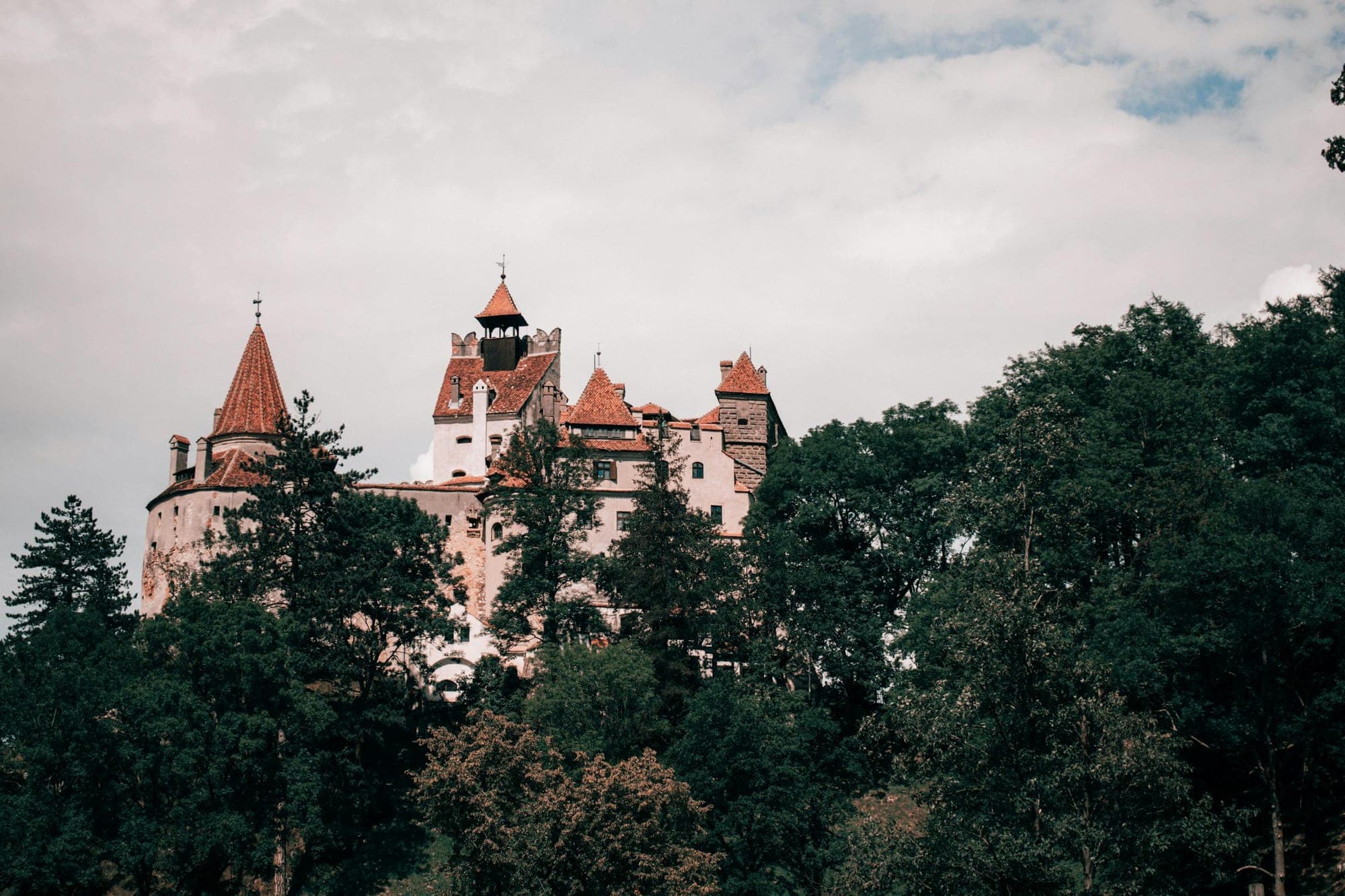
Before you step inside, take in the silhouette of the castle perched on its rock. Its story begins in 1211, when King Andrew the Second of Hungary granted this region — the Land of Bârsa — to the Teutonic Knights, who raised a first wooden fortification here. The knights were expelled a few years later, but the site was far too valuable to abandon: this pass was one of the natural gateways between Transylvania and Wallachia. In 1377, King Louis the First of Anjou granted the Saxons of Brașov the privilege of building, at their own expense, the stone castle you see before you today. For centuries Bran served as both military fortress and customs post: taxes were collected here on the goods crossing between the two regions. Its walls lived through sieges, fires and reconstructions. Then, in 1920, came the chapter that transformed the castle forever: the city of Brașov gifted Bran to Queen Marie of Romania, in gratitude for her role in the Great Union of 1918. The fortress of war became a royal home.
Read the text
Let's address the question everyone arrives with: did Dracula live here? The short answer is no — and the real story is even more interesting. The Irish writer Bram Stoker published his novel Dracula in 1897 without ever setting foot in Romania: he built his imaginary castle from books and maps. Of all the castles of Transylvania, Bran is the one that best matches his description: a gothic fortress, solitary, planted on a crag. That is why the world adopted it as Dracula's Castle. Stoker's character took his name from Vlad the Third, known as Vlad the Impaler, prince of Wallachia in the fifteenth century, famed for his merciless justice against enemies and traitors. Vlad knew this pass well — it linked his lands with Transylvania — and some chronicles suggest he may have been held briefly in the area; historians still debate it. What is certain is that here, among these stones, history and legend walk hand in hand. And that blend is precisely the charm of Bran: a real castle carrying, without ever asking to, the most famous myth in horror literature.
Read the text
You have reached the heart of the castle: the inner courtyard. Pause for a moment and let your gaze travel slowly around. The white façades, the wooden galleries and the outer staircases surround you like a small vertical village. In medieval times this courtyard was the centre of garrison life; in Queen Marie's day it filled with flowers and became a welcoming, almost Mediterranean corner. Notice the well, the courtyard's silent protagonist. It was dug straight into the living rock to a great depth, to guarantee water during sieges. Legend has it that a secret chamber was hidden inside it, where treasures were kept in times of danger. And there is more: in the twentieth century, a lift was installed inside the old well shaft — today it is part of the attraction known as the Time Tunnel. If your ticket includes it, you'll discover it at the end of your visit. From the courtyard, the staircases lead up to the museum rooms. Whenever you're ready, let's continue.
Read the text
One of every visitor's favourite moments: the secret staircase. This narrow passage, cut between the walls, connects the first floor with the third, and remained hidden for generations behind a fireplace. It was rediscovered in the 1920s, during the great restoration Queen Marie entrusted to the Czech architect Karel Líman — the same man who worked on Peleș Castle. Picture the scene: workmen tap on a wall, it sounds hollow, and a stone staircase appears that nobody remembered existed. In a frontier fortress, a passage like this was a life insurance policy: it allowed defenders to move between floors unseen, to escape, or to take the enemy by surprise. Climb slowly; the steps are uneven, and in places the passage is so tight that a person can barely fit through with shoulders squared. Feel the cold stone on either side. Rarely can you touch the defensive ingenuity of the Middle Ages at such close quarters.
Read the text
These reception rooms show the personal taste of Queen Marie, who turned an austere fortress into a warm home. The queen deeply loved Romanian folk art, and you will see it in every detail: carved wooden furniture of peasant inspiration, traditional ceramics, textiles and rugs with folk motifs, alongside Renaissance pieces brought from across Europe. In the dining room, the sturdy table and carved sideboards evoke the royal family's intimate dinners, far from the rigid protocol of the capital. Marie wrote that Bran was 'a fairy-tale castle', and she wanted every room to keep that spirit: low ceilings with wooden beams, lit fireplaces, corners for reading and conversation. Notice the windows too: they are small and deep — a legacy of defensive architecture — but the queen filled them with light and pale curtains. It is exactly this blend, half fortress, half home, that makes Bran unique among the royal castles of Europe.
Read the text
This room belonged to King Ferdinand the First, Queen Marie's husband and ruler of Romania from 1914 to 1927. Ferdinand was a reserved, cultured man, passionate about botany — very different from his wife's sweeping personality. Under his reign, after the First World War, Romania achieved the Great Union of 1918, which joined Transylvania to the Romanian Kingdom; that is why he was called 'Ferdinand the Loyal'. The furniture you see here is Renaissance-inspired, in dark, richly carved wood: an imposing bed, chests and period armchairs that speak of solidity and restraint. Look at the small personal objects and the portraits: they remind us that this castle was not a stage set but a home, lived in by a royal family in the interwar years. While Marie made Bran her favourite refuge, Ferdinand found here the silence that the court in Bucharest never allowed him. Take a moment to imagine the king by the window, gazing over the pass his medieval predecessors defended stone by stone.
Read the text
You are now entering the private world of the woman who gave this castle its soul: Queen Marie of Romania. Born a British princess — a granddaughter of Queen Victoria and of Tsar Alexander the Second — Marie came to Romania at seventeen and became the most beloved queen in its history. During the First World War she worked as a nurse in the front-line hospitals, and her courage won her the heart of the country. For English-speaking visitors there is a special thread here: this is the story of an English granddaughter of Victoria who became, in her own words, entirely Romanian. Her apartments at Bran reflect her personality: romantic, artistic, and deeply in love with Romanian style. You will see her bedroom with its Gothic and Byzantine-inspired furniture, her intimate sitting rooms, her writing desk — as if the queen had just stepped out. Marie mixed orthodox icons, peasant textiles and oriental objects without hesitation; an incense lamp, warm carpets, gilded wood. From these windows you can see the pass towards Wallachia, the view she described in her diaries. Bran was her favourite refuge until her death in July 1938. And as you will hear later, she left her heart here — quite literally.
Read the text
Music and books were an essential part of life at Bran. In this room, the royal family and their guests gathered in the evenings to play the piano, listen to songs and read aloud. Queen Marie, who wrote books and fairy tales of her own, and her youngest daughter, Princess Ileana, filled the castle with artistic evenings. Look at the period instruments and furniture: they speak of a time when entertainment was something you created at home, among friends, beside the fire. The shelves hold volumes in several languages, because this was a polyglot, European family: Marie wrote in English, Ferdinand read in German, and the children grew up between Romanian and French. Notice the decorative details, the lamps and the textiles: every object was chosen personally by the queen, who considered interior decoration an art form in its own right. Let the silence of the room suggest those melodies of the 1920s, when Bran hummed with family life.
Read the text
This part of the museum tells a moving story of loss and return. After Queen Marie's death in 1938, the castle passed to her favourite daughter, Princess Ileana, married to Archduke Anton of Austria. During the Second World War, Ileana founded a hospital beside the castle called 'The Heart of the Queen', where she herself worked as a nurse, following her mother's example. But in January 1948, the new communist regime expelled the royal family from Romania. Ileana went into exile with her children and ended her days in the United States as an Orthodox nun, Mother Alexandra. The castle was confiscated and, from 1957, run as a state museum. Decades later, democratic Romania returned Bran to its rightful heirs: in 2006 the castle was restituted to Archduke Dominic of Habsburg, Ileana's son, and his sisters. Since 2009 the family has run it as a private museum. The furniture and objects you see in these rooms form the family collection — pieces recovered and gathered once more under this roof, closing a circle of nearly a century.
Read the text
Every fortress keeps the memory of its battles, and this room gathers the instruments of war that defended the Bran pass for centuries. Study the swords, halberds, crossbows, maces and pieces of armour: weapons from the centuries when this castle was the fortified frontier between Transylvania and Wallachia. The garrison of Bran was never large — a few dozen soldiers — but the castle's position did the rest: from these towers the entire pass is in view, and no army could slip through unseen. Notice the early firearms, arquebuses and matchlock pistols, which from the sixteenth century onwards changed the art of war forever and forced medieval fortresses to adapt. Some pieces are hunting weapons — a reminder that these Carpathian forests were for centuries the realm of bears, wolves and wild boar, and of the royal hunts of the modern age. Every blade and every barrel here carries a question within it: how many hands did it serve, and what stories did it take part in that we will never know?
Read the text
Now look up: you are in the oldest and highest part of the castle, the keep — the donjon. In a medieval fortress, the keep was the last refuge: if the enemy breached the walls, the defenders shut themselves in here, with provisions and water, to resist to the end. In places the walls are several metres thick. Over the centuries the castle suffered fires, explosions and earthquakes, and was rebuilt again and again; that is why you will see stones from different eras side by side in the same wall, like the rings of an ancient tree. From the upper windows and guard posts, the view is simply magnificent: the Bran pass at your feet, the red roofs of the village, and in the distance the Bucegi and Piatra Craiului mountains. It is the same view once watched by the Saxon sentries and the soldiers of the garrison — and, centuries later, by a queen who chose this eagle's nest as her home. Take your time up here. Few postcard views of Romania are worth as much as this one.
Read the text
Transylvania never needed Dracula to fill itself with mysteries: its villages have been telling stories around the fire for centuries, and this part of the museum is devoted to that fascinating universe. Meet the strigoi, the restless dead of Romanian folklore who leave their graves at night to torment the living; they are the true ancestors of the literary vampire. Discover the iele, female spirits who dance in forest clearings and punish anyone who spies on them; the moroi; the pricolici — the wolf with a human soul — and the whole court of creatures that once explained the inexplicable: sudden illness, a failed harvest, the noises of the night. You will also learn the folk remedies: garlic at the windows, the doors of the soul that must be closed, the burial rituals. This is not mere superstition: it is how the communities of the Carpathians gave shape to their fears for centuries. Listen to these stories with respect and a smile, and you will understand why Bram Stoker — who never came here — chose precisely this land for his immortal novel.
Read the text
This is one of the most beautiful and singular stories of European royalty. Queen Marie died in July 1938 at Pelișor Castle, in Sinaia. In her will she left an extraordinary wish: that her body should rest beside the kings at the monastery of Curtea de Argeș, but that her heart should be removed and kept in her most beloved place, so it would remain close to the people she had loved. The heart was first laid in the Stella Maris chapel at Balchik, her paradise on the Black Sea. When that region passed to Bulgaria in 1940, the casket was brought here, to Bran, and placed in a small chapel carved into the rock across the stream, facing the castle; you can still see the spot during your walk in the park. In 1971 the heart was taken to Bucharest, to the National History Museum, and since 2015 it has rested once more at Pelișor Castle, in the very golden room where the queen closed her eyes. A travelling heart, for a queen who said she belonged, above all else, to Romania.
Read the text
Before we say goodbye to the interior, step up once more to a window or the terrace and look out over the valley. That corridor between the mountains is the Bran-Rucăr pass, and it is the reason for everything you have seen today. For centuries it was one of the most important trade routes of south-eastern Europe: caravans passed through here carrying Flemish cloth, spices from the East, salt, wax, fish and wine, linking the Saxon towns of Transylvania with the ports of the Danube and the Black Sea. The castle collected the customs duty: a share of every load that crossed. That money explains the walls around you. But the pass brought dangers too: up this same corridor came Ottoman and Tatar armies, and down it came Wallachian princes. Every stone of Bran exists to watch over this road. Today the pass is crossed by tourists and cyclists, and the towers fear no one. Think about that as you take in the landscape: few views in Europe sum up seven hundred years of trade, war and the meeting of worlds so well.
Read the text
Our route through the interior of Bran Castle ends here. You have walked through seven hundred years of history: from the Teutonic Knights and the Saxons of Brașov, through the medieval customs post and the wars with the Ottoman Empire, to Queen Marie's fairy-tale home and the universal myth of Dracula. Before you leave, a few more experiences await, if your ticket includes them. Track seventeen will accompany you into the Time Tunnel, the multimedia lift built inside the castle's old well. Track eighteen is devoted to the Torture Chambers and medieval justice. And track nineteen will guide you through the Royal Park, the lakes and the queen's Tea House — a walk that will also give you the finest photographs of the castle from below. If you have enjoyed this audio guide, it was created by Transylvania Private Tours, specialists in private tours across Transylvania. Thank you for your visit — and may the road bring you back to these mountains.
Extras with additional ticket
A separate ticket is required
Read the text
Get ready for the castle's most surprising experience: the Time Tunnel. You are about to descend through the inside of the mountain, within the old well shaft cut into the rock centuries ago. In the 1930s, Queen Marie had a lift installed here so she could travel comfortably from her castle down to the park; the first metres of the shaft still keep their original 1937 lining, protected today as a historic monument. The modern lift descends thirty-one and a half metres — the longest vertical run of its kind in Romania — and as you go down, the show begins: light, images, music composed especially for this place, and even an exclusively created scent wrap the cabin in a sensory journey through the history and legends of Bran. At the bottom, you continue on foot along a gallery of around forty metres, whose first sections preserve the stone of the old tunnel, until you emerge into the light of the Royal Park at the foot of the crag. It is, quite literally, a queen's secret passage: you entered a medieval castle, and you will leave the mountain as Marie did — straight into her gardens.
Read the text
You are entering the most chilling section of the castle: the exhibition of medieval instruments of torture. A word of warning: the pieces you are about to see are harsh, and the visit may not be suitable for young children. In medieval and early modern Europe, torture was not a hidden excess but part of judicial procedure: it was used to extract confessions, and as public, exemplary punishment. You will see sadly famous instruments: the rack, which stretched the accused's body; the iron maiden, its interior bristling with spikes; pillories, stocks and masks of shame that exposed the condemned to public humiliation; and interrogation tools whose mere sight explains why so many confessions were false. Remember that in those centuries, justice sought above all collective deterrence: punishment had to be seen. This collection does not aim to frighten, but to remind us where we come from: a world where pain was law, and one it took Europe centuries to leave behind. Afterwards, step out into the light of the courtyard and breathe: few museum rooms teach as much about the value of modern justice as this one.
Read the text
End your visit with a peaceful walk through the Royal Park, at the foot of the castle. This park was laid out in the 1920s for Queen Marie, who turned the fortress surroundings into a romantic garden with paths, meadows and two lakes that mirror the towers. Walk unhurried: from down here you will have the most spectacular views of the castle, perched on its sixty-metre crag — the classic image that has travelled the world. Beside the lake you will find the Tea House, built between 1923 and 1929 from wooden beams, in the shape of the letter L. It was the queen's favourite corner for receiving guests in privacy, away from protocol; today it houses the castle's restaurant, so you can sit exactly where royalty once sat. Across the stream you will see the small chapel carved into the rock where Queen Marie's heart rested between 1940 and 1971. And if you came down through the Time Tunnel, you already know the secret exit connecting the castle to these gardens. Enjoy the mountain air. Here ends our guide: thank you for walking this history with us.